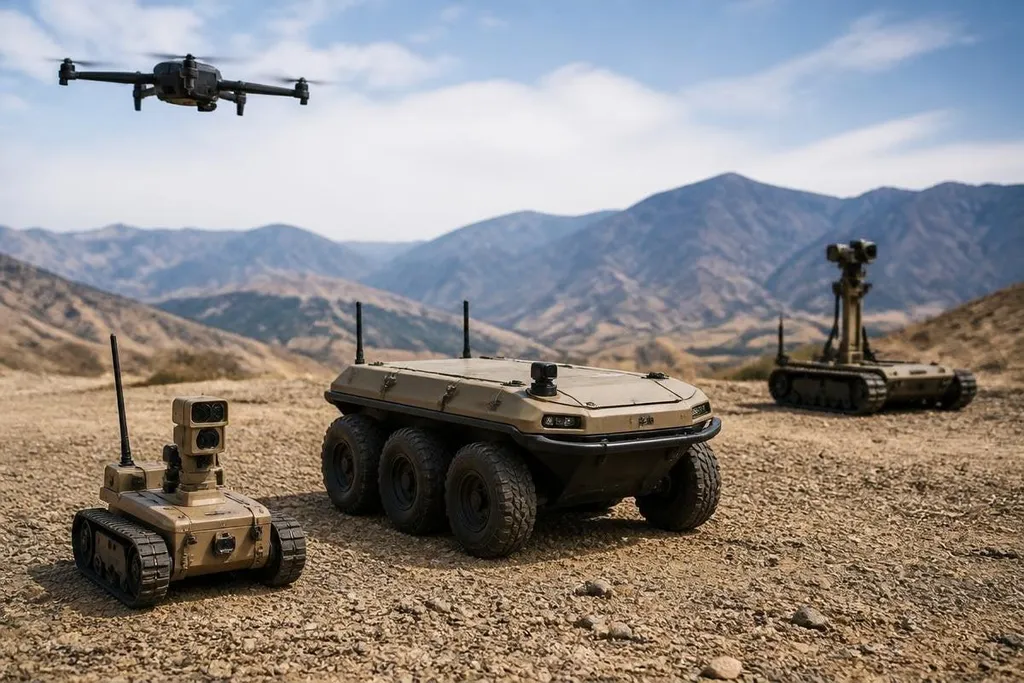
Military robots are moving from research labs into planning documents, test ranges, and public demonstrations. Without a supplied evidence pack, though, no honest ranking of countries, companies, or machines can be made.
- Public demos rarely show full operating limits.
- A useful comparison needs cost, range, control method, and test conditions.
- The hardest question is still deployment: who can use these systems safely outside a controlled site?
What the race includes
“Military robot” covers several very different systems. A small ground vehicle may carry a camera or radio. A larger unmanned vehicle may move supplies. An aerial system may watch an area, map terrain, or carry equipment.
Those jobs need different hardware. A tracked vehicle needs traction and protection. A flying system needs enough battery power to stay airborne. A remote arm needs force sensing and a control link that can handle delay.
That makes a single league table a poor fit. A robot built for inspection can't be judged by the same measure as one built to carry cargo. The job comes first.
The parts that decide real use
Control is one of the first dividing lines. A remotely operated robot needs a person sending commands over a radio or network link. An autonomous robot makes some choices on its own, using sensors and software to act when the link is weak or absent.
That change affects safety, training, and legal review. A system that stops when its signal drops has a different risk from one that continues moving after contact with its operator is lost. Any serious report should state which mode the machine uses.
Sensors matter for the same reason. Cameras can show a scene, while LiDAR measures distance with laser pulses. Neither removes the need for a human plan when dust, smoke, weather, damaged terrain, or blocked signals interfere with the data.
A contract or field trial gives a military robot claim a record you can check. Military robotics reports from Robot24.com can name the machine, task, date, and test site before the article looks at what public claims leave out.
What public claims leave out
A short video can show that a robot completed one task. It doesn't show how many tries came before the clip, how often the system failed, or how much staff and equipment supported the run.
A useful report needs the test setting beside the result. That means the robot's weight, payload, battery time, speed, control mode, weather, terrain, and failure rate when those figures are available.
Cost also changes the picture. The purchase price may leave out spare batteries, remote controls, training, repairs, software fees, transport, and the people needed to run the system. A low unit price can still lead to a large field bill.
I'd treat any claim of a decisive military lead as unproven until the source names the test, the date, and the result.
A buyer's evidence checklist
Use these checks before accepting a claim about a military robot:
- Name the task: Check whether the machine carries cargo, watches an area, maps terrain, removes hazards, or performs another defined job.
- Check the control link: Find out what happens when the radio or network connection weakens or fails.
- Read the test conditions: Look for terrain, weather, payload, battery time, speed, and the number of runs.
- Separate robot cost: Ask if training, repairs, spare parts, software, transport, and staff are included.
- Find the human role: Note who starts the task, who can stop it, and who reviews its decisions.
- Mark the unknowns: Record claims that have no public test data or independent check.
What should happen next
The next useful step is a shared record of tests, not another video assembled from short clips. Military buyers need results that show failure as clearly as success, since a lost signal or empty battery can matter more than a clean demonstration.
No evidence pack was supplied for this topic, so country rankings, company names, prices, dates, and deployment counts remain unverified here. Until those details are public and comparable, the global race cannot be ranked with confidence.